Molarity is the single most important way chemists describe how concentrated a solution is. Whether you are titrating an acid in a teaching lab, preparing a reagent for a PCR, or formulating a product on a production line, the number that tells you the strength of a solution is almost always a molarity. This guide explains exactly what that number means, where the formula comes from, and how to use it without second-guessing yourself.
The definition of molarity
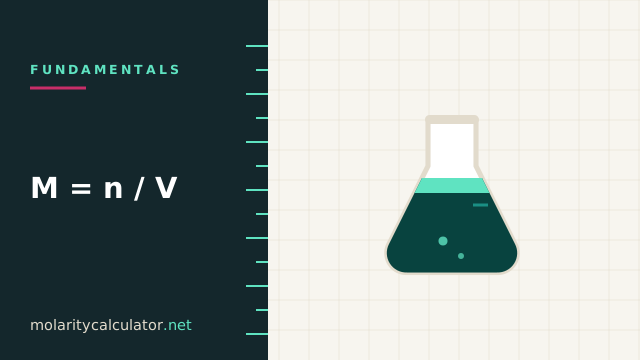
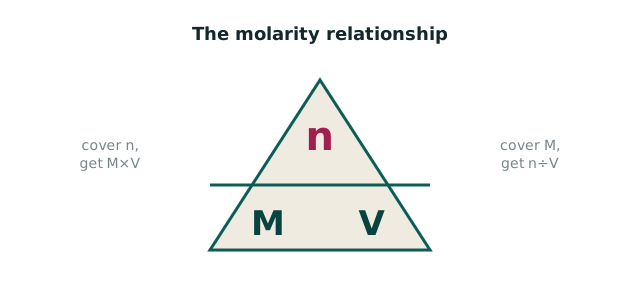
Molarity, also called molar concentration, is the number of moles of solute dissolved in one litre of solution — not one litre of solvent. That distinction matters: you dissolve the solute first and then make the mixture up to the final volume, so the solute itself contributes to the total volume. The symbol is an italic capital M, and the units are moles per litre (mol/L), routinely written simply as M and read aloud as “molar.”
Here n is the amount of solute in moles and V is the volume of the finished solution in litres. A solution labelled 2 M sodium chloride contains two moles of NaCl in every litre. Because a mole is just a fixed count of particles (6.022 × 10²³ of them), molarity is ultimately a statement about how many solute particles are crowded into a given volume.
Going from grams to molarity
You almost never weigh out moles directly — balances read in grams. The bridge between the two is molar mass (the mass of one mole, in g/mol), which you get by adding up the atomic masses in the chemical formula. The full working relationship is:
Rearranging this one equation lets you solve for whichever quantity you are missing. Need the concentration from a known mass? Divide. Need the mass to hit a target molarity? Multiply. The molarity calculator on the home page does exactly this and shows each step.
A worked example
Suppose you dissolve 10 g of sodium chloride (molar mass 58.44 g/mol) and make the solution up to 500 mL. First convert mass to moles: 10 ÷ 58.44 = 0.171 mol. Then convert millilitres to litres: 500 mL = 0.5 L. Finally divide: 0.171 ÷ 0.5 = 0.342 M. The whole calculation hinges on keeping volume in litres — the most common slip in the entire topic.
Always convert millilitres to litres before dividing. Forgetting this single step causes more wrong answers in solution chemistry than anything else. 250 mL is 0.25 L, not 250.
Molarity versus molality
The two terms sound nearly identical and are endlessly confused. Molarity (M) is moles of solute per litre of solution and depends on volume. Molality (m) is moles of solute per kilogram of solvent and depends on mass. Because volume expands when a solution is heated while mass does not, molarity changes with temperature and molality does not. For everyday bench work at room temperature you will use molarity; molality appears mostly in colligative-property calculations. We compare them fully in molarity vs molality.
Common concentration units you will meet
Molarity has cousins. Millimolar (mM) is one-thousandth of a molar and micromolar (µM) is one-millionth — both are everywhere in biology, where solutions are dilute. Percentage concentrations (% w/v, % v/v) and parts per million (ppm) describe the same idea in mass or volume terms rather than moles, covered in our guide to percent concentration solutions.
Where molarity is actually used
Molarity underpins stoichiometry in solution, the design of buffers, the standardisation of titrants, the preparation of cell-culture media, and the dosing of reagents in synthesis. Anywhere a reaction happens in a liquid, the rate and the yield depend on how many reactant particles are present per unit volume — which is precisely what molarity measures. That universality is why it became the default unit and why an accurate, fast way to compute it saves time on almost every experiment.
Recommended lab gear
Some links below are affiliate links. As an Amazon Associate we earn from qualifying purchases, at no extra cost to you. See our affiliate disclosure.
Volumetric Flask Set (Class A)
Class A borosilicate flasks for making solutions to an exact volume.
View on Amazon