Calculating molarity is not hard, but it is easy to get wrong if you skip a step or lose track of units. This guide gives you a method you can run the same way every time, whether the question hands you grams, moles, or millilitres. Follow the order and the answer falls out.
The four-step method
- Identify what you are solving for. Molarity, mass, moles, or volume? Write the symbol down. This decides which form of the equation you need.
- Convert everything to base units. Volume to litres, mass to grams. Do this before you touch the formula, not during it.
- Get moles. If you were given grams, divide by molar mass. If you were given moles, you are already there.
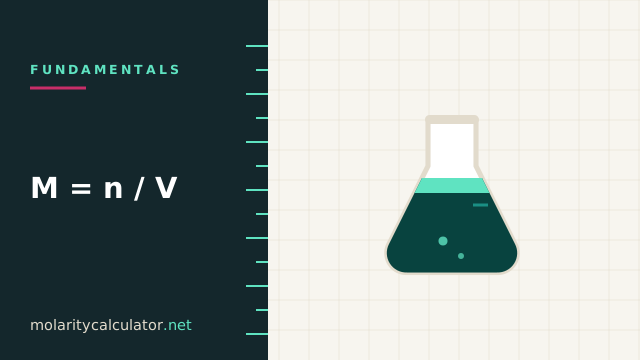
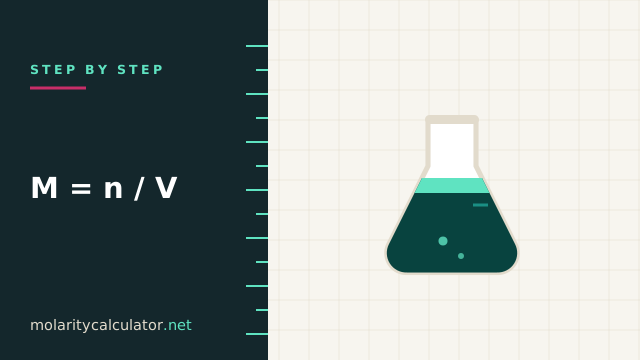
- Apply M = n ÷ V. Divide moles by litres, then sanity-check the size of the answer.
Example: molarity from grams
Calculate the molarity when 8.0 g of sodium hydroxide (NaOH, molar mass 40.0 g/mol) is dissolved to make 250 mL of solution. Convert volume: 250 mL = 0.250 L. Moles: 8.0 ÷ 40.0 = 0.200 mol. Molarity: 0.200 ÷ 0.250 = 0.800 M. A sub-1 M answer for a few grams in a quarter litre is reasonable, so the result passes the sanity check.
Example: mass needed for a target molarity
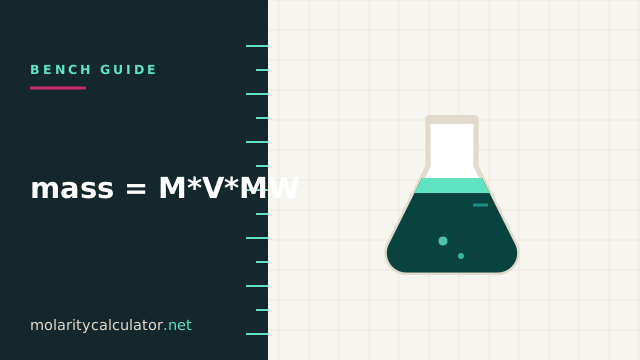
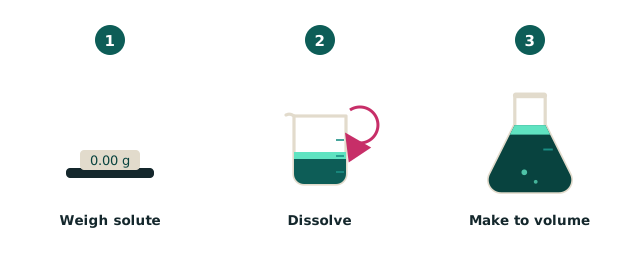
How many grams of glucose (C6H12O6, 180.16 g/mol) make 100 mL of a 0.50 M solution? Use mass = M × V × MW = 0.50 × 0.100 × 180.16 = 9.0 g. Weigh out 9.0 g, dissolve, and make up to 100 mL.
The formula is symmetric. The molarity calculator simply rearranges the same equation depending on the box you leave blank — you never have to memorise four formulas, only one.
Unit conversions you will need
| From | To | Operation |
|---|---|---|
| millilitres (mL) | litres (L) | ÷ 1000 |
| microlitres (µL) | litres (L) | ÷ 1,000,000 |
| milligrams (mg) | grams (g) | ÷ 1000 |
| millimolar (mM) | molar (M) | ÷ 1000 |
| micromolar (µM) | molar (M) | ÷ 1,000,000 |
Mistakes that cost marks and reagents
The recurring errors are predictable: dividing by millilitres instead of litres, using anhydrous molar mass while weighing a hydrate, and rounding the molar mass too early. Keep one extra significant figure through the working and round only at the end. For a fuller list see common solution-preparation mistakes.
Check your work instantly
Once you understand the method, verify every answer with the molarity calculator: it shows the substituted numbers so you can confirm you converted units correctly rather than just trusting a single output. Treat the tool as a second pair of eyes, not a substitute for understanding the steps.
Recommended lab gear
Some links below are affiliate links. As an Amazon Associate we earn from qualifying purchases, at no extra cost to you. See our affiliate disclosure.
Volumetric Flask Set (Class A)
Class A borosilicate flasks for making solutions to an exact volume.
View on Amazon