Two of the most confused terms in all of chemistry differ by a single letter: molarity and molality. They are not interchangeable, and using the wrong one quietly corrupts colligative-property calculations. This guide makes the difference stick.
The two definitions, side by side
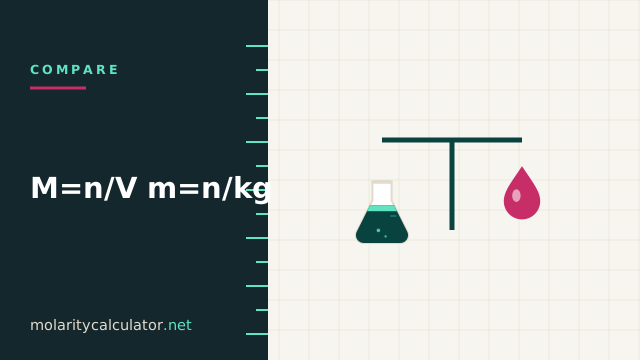
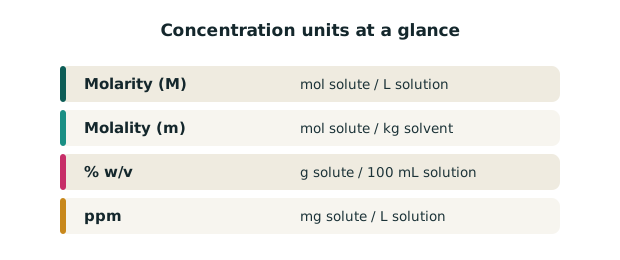
Molarity (capital M) is moles of solute per litre of solution. Molality (lower-case m) is moles of solute per kilogram of solvent. The numerator is the same in both — moles of solute. Everything turns on the denominator: a volume of the whole mixture versus a mass of the liquid you dissolved into.
Why temperature is the deciding factor
Liquids expand when warmed. Heat a 1 M solution and its volume grows, so the same moles now occupy more litres — the molarity drops even though nothing was added or removed. Mass, by contrast, is conserved at any temperature, so molality is temperature-independent. That is why molality is the unit of choice whenever temperature changes are part of the experiment, such as freezing-point depression and boiling-point elevation.
Rule of thumb: if the experiment involves heating, freezing, or precise thermodynamics, reach for molality. If you are pipetting at the bench and care about volume, molarity is almost always what you want.
When the two are nearly equal
For dilute aqueous solutions near room temperature, the density of water is close to 1 kg/L, so a litre of solution contains roughly a kilogram of solvent and molarity and molality come out almost the same. The gap widens for concentrated solutions, non-aqueous solvents, and temperatures far from 25 °C. Never assume they are equal for anything but dilute aqueous systems.
Converting between them
To convert you need the solution density. From molarity, work out the mass of solute and the total mass of one litre of solution using density, subtract to get the solvent mass, and divide moles by that mass in kilograms. The arithmetic is fiddly precisely because it forces you to confront which denominator each unit uses — which is the whole lesson.
Quick reference
| Molarity (M) | Molality (m) | |
|---|---|---|
| Denominator | litres of solution | kilograms of solvent |
| Temperature-dependent? | Yes | No |
| Typical use | titrations, bench work, dosing | colligative properties |
| Needs density to convert? | Yes, in both directions | |
Recommended lab gear
Some links below are affiliate links. As an Amazon Associate we earn from qualifying purchases, at no extra cost to you. See our affiliate disclosure.