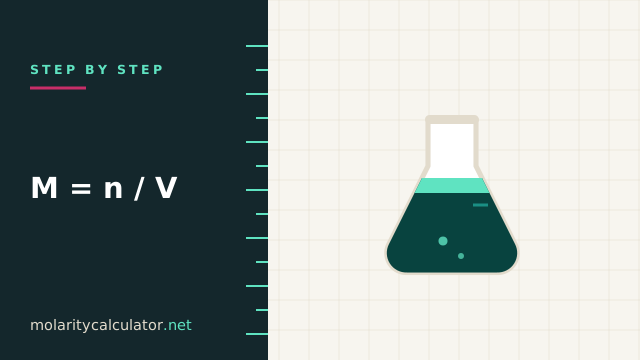
Most solutions in a lab are not made from scratch — they are diluted from a concentrated stock. Mastering the dilution equation means you can hit any working concentration from a single bottle of stock, and serial dilution extends that to concentrations far too low to measure in one step.
The dilution equation
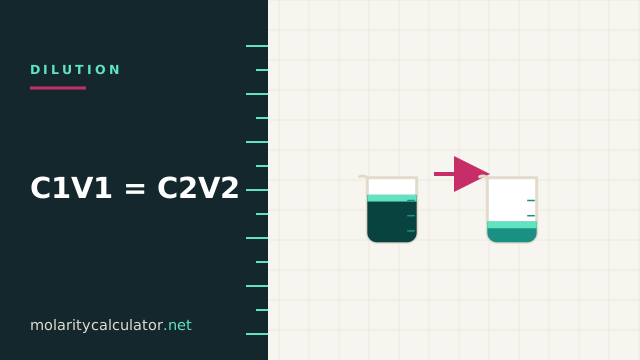
When you dilute a solution you add solvent, but the number of moles of solute does not change. Since moles equals concentration times volume, the product of concentration and volume is conserved:
C₁ and V₁ are the concentration and volume of the stock you take; C₂ and V₂ are the concentration and volume of the diluted solution you want. Give any three and the fourth is fixed. The dilution calculator solves for whichever one you leave blank.
A worked dilution
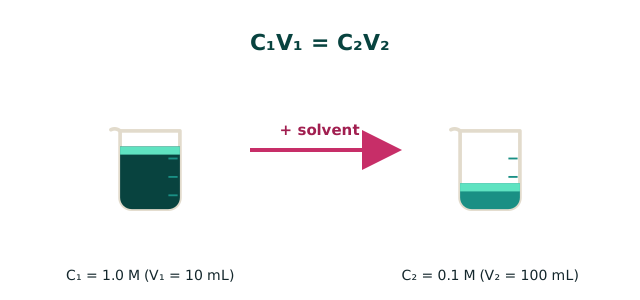
You have a 1.0 M HCl stock and need 100 mL of 0.10 M HCl. Solve for V₁: V₁ = C₂V₂ ÷ C₁ = (0.10 × 100) ÷ 1.0 = 10 mL. Take 10 mL of stock and add solvent up to 100 mL total. Always add concentrated acid to water, never the reverse.
When diluting concentrated acids, add acid to water slowly with mixing. The reverse can boil and spit. The phrase to remember is “do as you oughta, add acid to water.”
Dilution factor
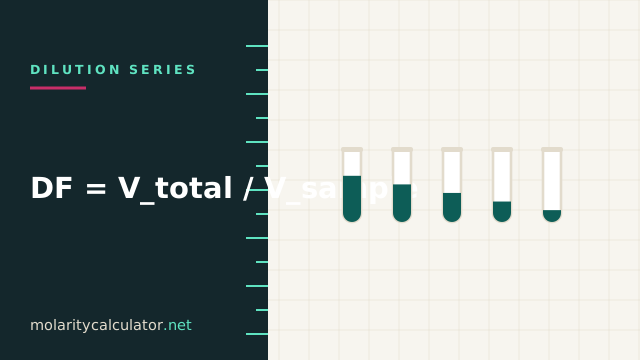
The dilution factor is the ratio of final to initial volume, or equivalently of initial to final concentration. A 10 mL stock made up to 100 mL is a ten-fold dilution, written 1:10, and the concentration drops by the same factor. Thinking in factors is faster than re-deriving volumes every time.
Serial dilution
To reach very low concentrations — nanomolar standards, bacterial counts, antibody titres — a single dilution would require impractically tiny or huge volumes. Serial dilution solves this by repeating a modest dilution several times. Each step multiplies the previous dilution factor.
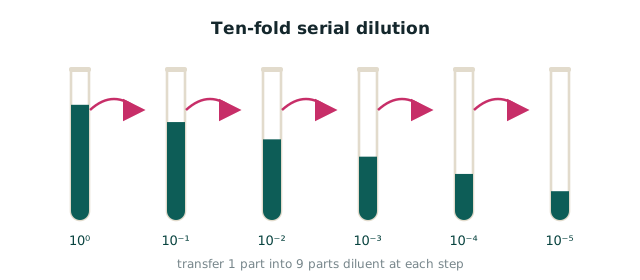
For a ten-fold series, transfer one part of solution into nine parts of fresh diluent, mix, then repeat from the new tube. After three steps you are at one-thousandth of the original; after six, one-millionth. Use a fresh tip at each step and mix thoroughly, because carryover and incomplete mixing are the dominant sources of error.
Where serial dilutions are used
Serial dilutions build standard curves for spectrophotometry and ELISA, generate countable plates in microbiology, and produce dose ranges in pharmacology. The technique is covered in depth, with a focus on cell work, in our guide to serial dilutions for cell culture and microbiology.
Recommended lab gear
Some links below are affiliate links. As an Amazon Associate we earn from qualifying purchases, at no extra cost to you. See our affiliate disclosure.
Volumetric Flask Set (Class A)
Class A borosilicate flasks for making solutions to an exact volume.
View on Amazon