pH is one of the most familiar numbers in science, but it is fundamentally a statement about molarity — specifically, the molar concentration of hydrogen ions. Understanding that link turns pH from a memorised scale into something you can calculate and reason about.
pH is a concentration on a log scale
pH is defined as the negative base-ten logarithm of the hydrogen-ion concentration in mol/L:
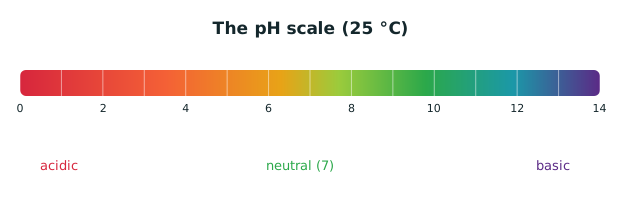
The logarithm compresses an enormous range of concentrations into a tidy 0–14 scale. Each whole pH unit is a ten-fold change in hydrogen-ion molarity: pH 3 has ten times the H+ of pH 4 and a hundred times that of pH 5.
pOH and the water relationship
The hydroxide concentration has its own measure, pOH = −log[OH−]. In water at 25 °C the two are tied together because the product of the ion concentrations is fixed:
So if you know one, you know the other. A solution of pOH 2 has pH 12, strongly basic.
Calculating the pH of a strong acid
Strong acids dissociate completely, so the hydrogen-ion concentration equals the acid's molarity. For 0.01 M HCl, [H+] = 0.01 M and pH = −log(0.01) = 2. This direct equality is exactly why an accurate molarity matters: the pH follows immediately from it.
Calculating the pH of a strong base
For a strong base, find pOH from the hydroxide molarity, then subtract from 14. A 0.001 M NaOH solution has [OH−] = 0.001 M, pOH = 3, and therefore pH = 11. For bases that release more than one hydroxide per formula unit, such as Ca(OH)2, double the concentration first — the link to normality.
Weak acids and bases only partly dissociate, so [H⁺] is not equal to the molarity. Their pH needs the acid dissociation constant Ka and an equilibrium calculation, which is a separate topic from the strong-acid shortcuts here.
From pH back to molarity
Reverse the definition to recover the concentration: [H+] = 10−pH. A solution of pH 4.5 has a hydrogen-ion molarity of 10−4.5 = 3.2 × 10⁻⁵ M. Being fluent in both directions — concentration to pH and back — is the core skill, and it all rests on molarity.
Recommended lab gear
Some links below are affiliate links. As an Amazon Associate we earn from qualifying purchases, at no extra cost to you. See our affiliate disclosure.