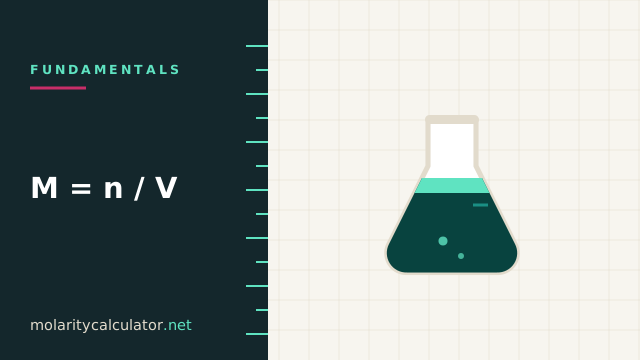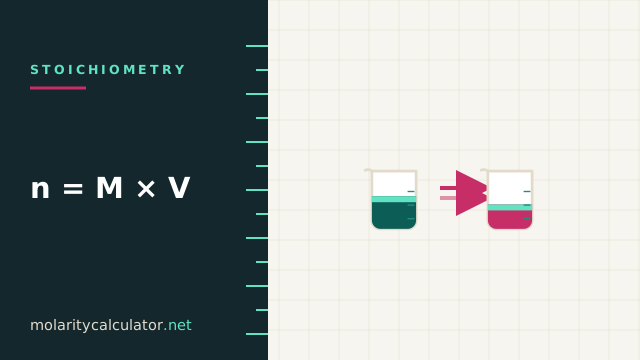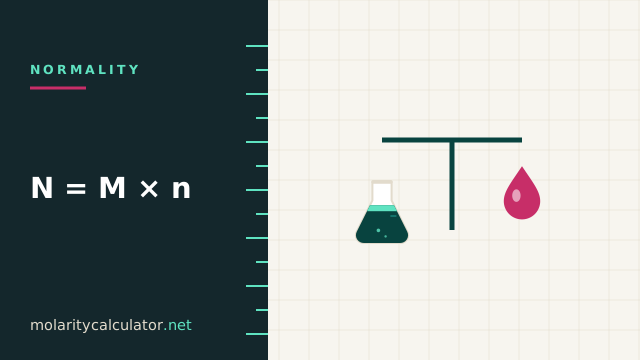
Normality is an older concentration unit you will still meet in titration handbooks, water-quality reports, and standardised reagent labels. It is closely related to molarity but counts reactive capacity rather than molecules, which makes it convenient for acid-base and redox titrations — and confusing if you are not told the reaction.
What normality measures
Normality (N) is the number of equivalents of solute per litre of solution. An equivalent is the amount that supplies or reacts with one mole of reactive units — protons in acid-base chemistry, or electrons in redox chemistry. It is related to molarity by a simple factor:
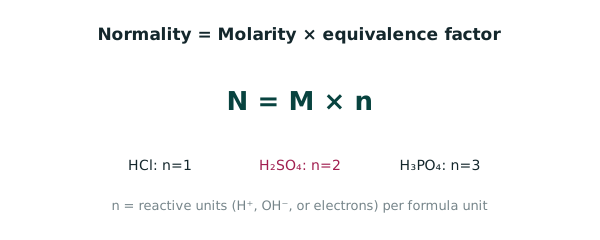
Here n is the number of reactive units per formula unit. For hydrochloric acid, which donates one proton, n = 1 and normality equals molarity. For sulfuric acid, which can donate two protons, n = 2, so 1 M H2SO4 is 2 N.
Worked examples
- 1 M HCl → 1 N (one proton per molecule)
- 1 M H2SO4 → 2 N (two protons)
- 1 M H3PO4 → 3 N if fully neutralised
- 1 M Ca(OH)2 → 2 N (two hydroxides)
Normality is reaction-dependent. Phosphoric acid is 1, 2, or 3 normal for the same molarity depending on how many of its protons are neutralised in the reaction you are running. Always state the reaction when you quote a normality.
Why titrations liked normality
At the equivalence point of a titration, equivalents of acid equal equivalents of base. Working in normality lets you write NAVA = NBVB regardless of how many protons each species carries, which once simplified calculations done by hand. Modern practice mostly uses molarity with explicit stoichiometry, but normality persists where it remains convenient.
Should you use it today?
For new work, molarity plus a balanced equation is clearer and less error-prone because it does not hide the reaction inside the unit. But you must be able to read normality to interpret standardised titrants and legacy methods. Convert to molarity by dividing by the equivalence factor and proceed as usual; the molarity calculator then handles the rest.
Recommended lab gear
Some links below are affiliate links. As an Amazon Associate we earn from qualifying purchases, at no extra cost to you. See our affiliate disclosure.