Everything quantitative in chemistry — molarity included — rests on the mole. It sounds abstract, but the idea is no stranger than buying eggs by the dozen: the mole is simply a very large, fixed-size counting unit for particles too small and numerous to count individually.
A counting unit for atoms
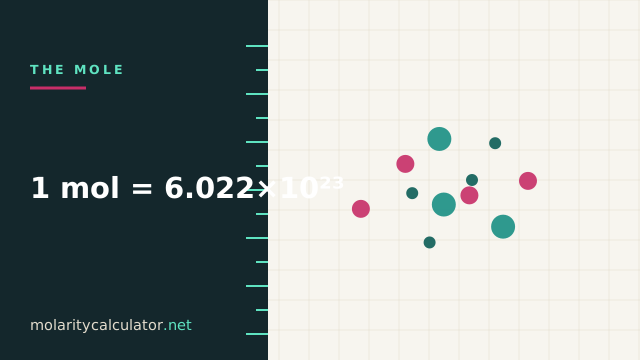
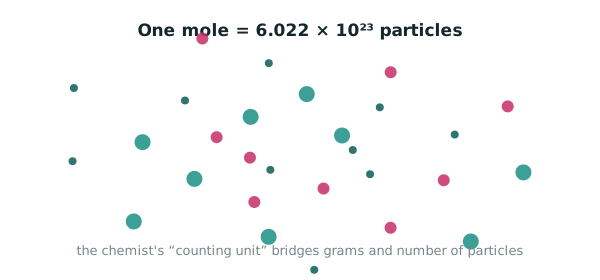
Atoms and molecules are so tiny that any weighable sample contains an astronomical number of them. Rather than write out those numbers, chemists group particles into moles. One mole is defined as exactly 6.022 × 10²³ particles — Avogadro's number — whether those particles are atoms, molecules, or ions.
Why such a strange number
Avogadro's number was chosen so that one mole of a substance has a mass in grams equal to its average particle mass in atomic mass units. Carbon-12 atoms each weigh 12 u, and one mole of them weighs 12 g. This neat correspondence is what makes molar mass usable: the periodic-table mass of an element is also the mass of one mole of it.
The mole and molar mass
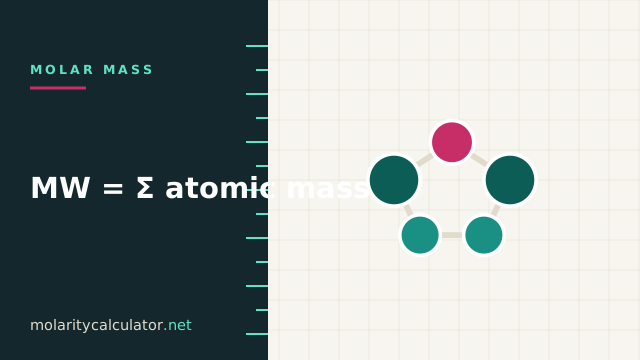
Molar mass turns the mole from a count into something you can weigh. Because one mole of water weighs 18 g, weighing 18 g of water means measuring out 6.022 × 10²³ molecules without ever counting one. This is the conversion every molarity calculation depends on — see molar mass and molecular weight for the calculation.
Three conversions the mole unlocks
- Mass ↔ moles using molar mass (grams ÷ g/mol).
- Moles ↔ particles using Avogadro's number.
- Moles ↔ volume of solution using molarity (mol/L).
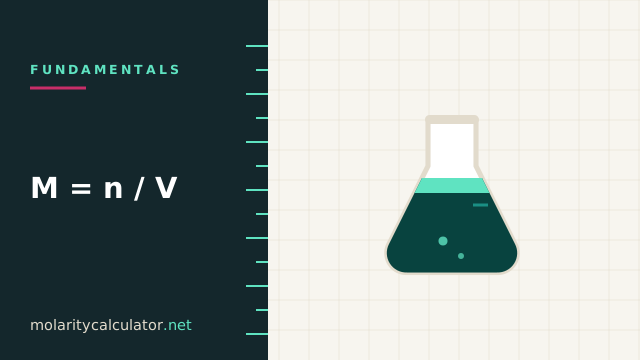
Molarity is the third of these conversions. It is why the mole and molar concentration are inseparable: molarity is just moles per litre.
Moles of gas
For gases there is a fourth bridge: at a fixed temperature and pressure, one mole of any ideal gas occupies the same volume — about 22.4 L at standard conditions. This lets chemists convert gas volumes to moles directly, the gas-phase counterpart of molarity in solution.
Why the mole makes chemistry work
Reactions combine particles in whole-number ratios, but we can only measure mass and volume. The mole is the translator between the two worlds: it lets a balanced equation written in particles be carried out with a balance and a flask. Master the mole and the rest of quantitative chemistry, molarity first among it, follows naturally.
Recommended lab gear
Some links below are affiliate links. As an Amazon Associate we earn from qualifying purchases, at no extra cost to you. See our affiliate disclosure.