In microbiology and cell culture you often need a concentration far below anything you can measure directly — a few hundred colonies on a plate from a culture of billions, or a picomolar point on a dose-response curve. Serial dilution gets you there in controlled, repeatable steps. Done carelessly, it is also a leading source of irreproducible data, so technique matters as much as arithmetic.
Why dilute in series
A single huge dilution — say one part in a million — would mean pipetting an unmeasurably small volume into a large one, and any error is magnified by the full factor at once. Splitting it into several ten-fold steps keeps every transfer in an accurate volume range and spreads the risk, so a small slip in one step does not wreck the whole series.
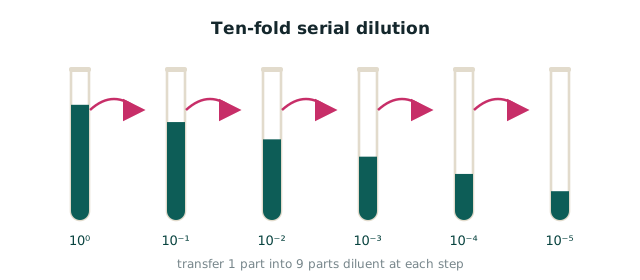
The dilution factor
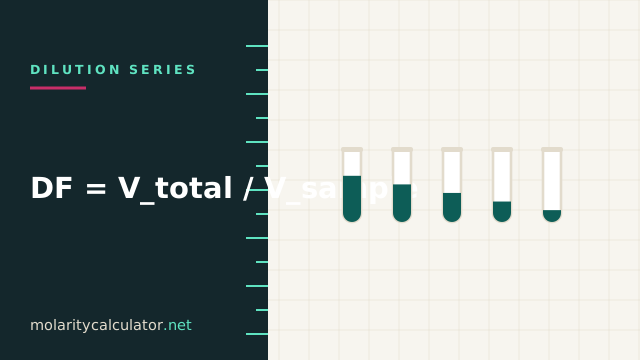
Each step has a dilution factor equal to the total volume divided by the sample volume transferred. Transferring 0.1 mL into 0.9 mL gives a total of 1.0 mL and a factor of 10. The factors multiply: after three ten-fold steps the cumulative dilution is 10 × 10 × 10 = 1000, written 103.
Back-calculating from plate counts
In viable counting you plate a diluted sample, count colonies, then multiply back by the total dilution factor to find the original concentration. If a plate from the 10−5 dilution yields 150 colonies from 0.1 mL plated, the original titre is 150 × 105 ÷ 0.1 = 1.5 × 10⁸ CFU/mL. Count only plates with roughly 30–300 colonies for statistical reliability.
Technique that protects accuracy
- Fresh tip every step. Carryover on a reused tip inflates later concentrations.
- Mix completely. Vortex or pipette up and down before drawing the next sample, or the gradient is wrong from the start.
- Pre-wet the tip. Aspirate and expel once before the real transfer to improve volume accuracy with aqueous samples.
- Work in a sensible volume range. Keep transfers within the accurate band of your micropipette.
Inconsistent mixing between steps is the single biggest cause of noisy dilution series. A few seconds of vortexing per tube pays for itself in clean, reproducible curves.
Standard curves and dose ranges
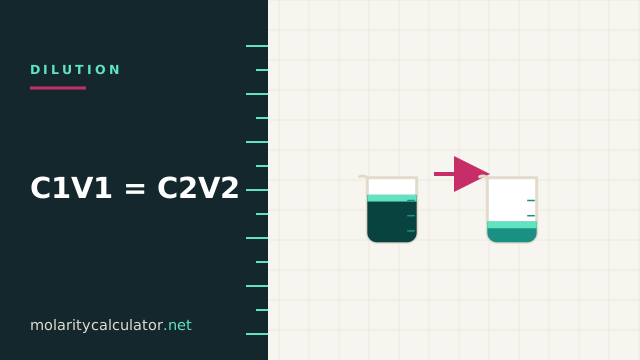
Serial dilution also builds the calibration curves behind spectrophotometry and ELISA, and the dose ranges used in pharmacology and toxicology. Even spacing on a logarithmic scale — which ten-fold or two-fold series produce naturally — gives the most information across a wide concentration range. The underlying maths is the same C₁V₁ = C₂V₂ covered in dilution and serial dilution, and the dilution calculator will plan each step for you.
Recommended lab gear
Some links below are affiliate links. As an Amazon Associate we earn from qualifying purchases, at no extra cost to you. See our affiliate disclosure.