When a solute is present in tiny amounts — contaminants in water, trace metals, dissolved gases — molarity and percentages give awkward strings of zeros. Parts per million (ppm) and parts per billion (ppb) are the natural units at this scale, and they appear constantly in environmental, food, and analytical work.
What ppm and ppb mean
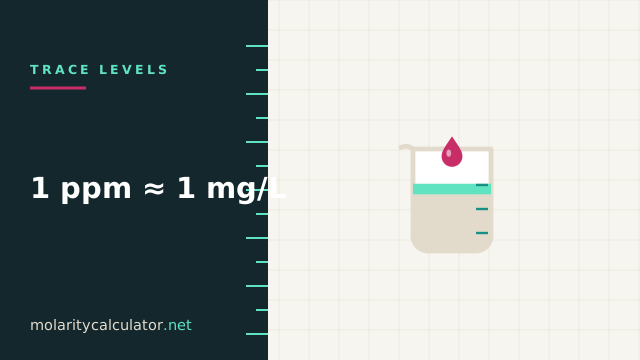
One part per million is one unit of solute in a million units of solution; one part per billion is one in a billion. They are ratios, so the units must match top and bottom. For dilute aqueous solutions, a convenient and widely used approximation makes them practical:
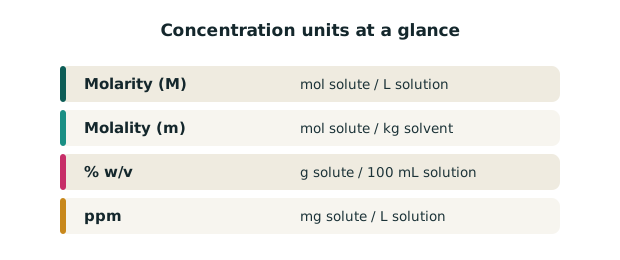
This works because one litre of dilute water solution weighs almost exactly one kilogram (a million milligrams), so one milligram of solute per litre is one part per million by mass. The approximation holds well for dilute aqueous solutions and is the basis of most reported values.
Everyday examples
- Drinking-water fluoride is typically around 0.7 ppm, or 0.7 mg/L.
- A safe-water lead limit of 10 ppb means 10 µg/L.
- Dissolved oxygen in a healthy stream is several ppm.
Converting ppm to molarity
Because ppm in water is mg/L, convert to molarity by turning milligrams into grams and dividing by the molar mass:
For example, 40 ppm of calcium (40 mg/L, molar mass 40.08 g/mol) is (40 ÷ 1000) ÷ 40.08 = 0.001 M, or 1 mM. The molar mass calculator gives the MW and the molarity calculator checks the result.
ppm by mass and ppm by volume are not the same for gases or non-aqueous systems. The 1 ppm = 1 mg/L shortcut applies to dilute aqueous solutions; state your basis when precision matters.
Going lower
Below ppb lies parts per trillion, used for ultra-trace contaminants detectable only by sensitive instruments such as ICP-MS. The same ratio logic applies; only the prefix changes. Whatever the scale, expressing trace amounts as a clean ratio keeps the numbers readable.
Recommended lab gear
Some links below are affiliate links. As an Amazon Associate we earn from qualifying purchases, at no extra cost to you. See our affiliate disclosure.